
How to Play Catdoku: Rules, Controls & Strategy Guide
Master the three rules of Catdoku and learn five zero-guess logic patterns to solve 5x5, 6x6, 7x7, and 8x8 grids faster.
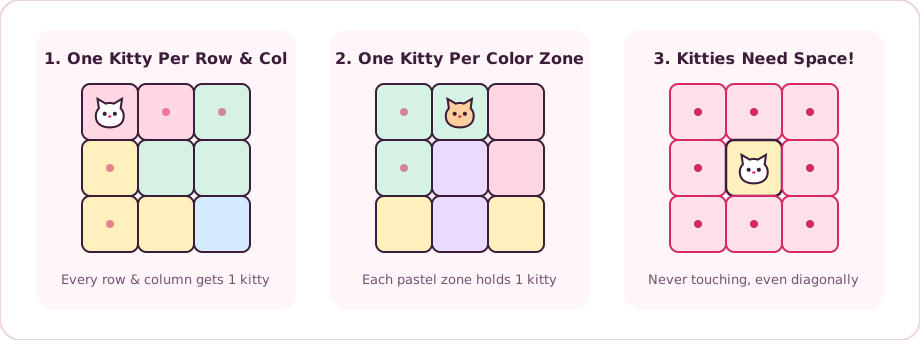
Catdoku looks deceptively simple at first glance: a pastel grid divided into irregular territories where every row, column, and color zone needs one cat, and no two cats may ever touch. Yet on 7x7 and 8x8 boards, recognizing a handful of repeatable deduction patterns turns tough puzzles into smooth, zero-guess solves.
Understanding the Three Rules of Catdoku
Before diving into advanced deductions, keep all three constraints working together in your head at all times:
- Row and Column Uniqueness: Every horizontal row holds exactly one cat, and every vertical column holds exactly one cat. On a 7x7 Catdoku grid, you are placing exactly 7 cats.
- Color Zone Uniqueness: Every contiguous colored region must contain exactly one cat, regardless of whether that zone has 2 tiles or 10 tiles.
- The No-Touching Halo: No two cats can share an edge or a diagonal corner. Placing a cat blocks all 8 squares immediately surrounding it.
Unlike classic Sudoku, you never eliminate long lists of candidate numbers. Instead, every placement removes an entire cross of rows and columns plus a 3x3 halo around the cat.
Beginner Controls That Speed Up Every Solve
Mastering the board controls saves more seconds than rushing your logic:
- Single Tap / Click: Cycles an empty square to an X mark, then to a cat, then back to empty.
- Drag to Sweep X Marks: Press and slide your mouse or finger across empty tiles to cross out entire rows, columns, or territories in one stroke.
- Right-Click Shortcut (Desktop): Right-clicking any square immediately places or removes a cat without passing through the X state.
- Auto-X Helper: With Auto-X switched on, placing a cat automatically dots out its row, column, zone, and surrounding 8 tiles without erasing your manual X marks. If you remove that cat later, those temporary helper dots vanish cleanly.
- Undo and Smart Hints: Every tap and drag is recorded in the undo history. If you hit a wall, the Hint button checks first for any misplaced cat that creates a dead end, and otherwise reveals the safest cat in the smallest remaining zone.
Five Zero-Guess Catdoku Solving Techniques
1. Always Start With 1-Tile, 2-Tile, and Straight-Line Zones
Your opening scan should always hunt for the smallest territories. A 1-tile zone is an instant forced cat. Next, look for any territory whose remaining squares all lie inside a single row or a single column. Even if you do not yet know which square in that strip holds the cat, you know for certain that the row or column's cat belongs to that zone—so every other square in that same row or column can be marked with an X immediately.
2. Use the 2-Square Neighbor Overlap
Suppose the Peach zone has only two open squares left, sitting directly beside each other horizontally. Look at the two squares directly above them and the two squares directly below them. Those four bordering tiles are adjacent (either orthogonally or diagonally) to both possible cat positions in the Peach zone. No matter which of the two Peach squares receives the cat, those shared neighbors are guaranteed to be blocked, so mark them X right away.
3. Spot the L-Shape Inner Corner
When a three-square territory forms a small L-shape, one empty square sits nestled inside the inner bend of the L. Check all three squares of that L-shape: every single one of them touches that inner corner square (two by edges, one diagonally). Because the L-shape must contain a cat somewhere, the inner corner square can never hold a cat. Crossing out that single tile often unlocks the entire neighboring territory.
4. Count Color Zones Locked Inside Two or Three Rows
As a 7x7 or 8x8 Catdoku board thins out, look at rows or columns as groups. If two separate color zones are completely contained within Rows 1 and 2, those two zones must claim the two cats allowed in Rows 1 and 2. Any third color zone that happens to poke a few tiles into Row 1 or Row 2 cannot place its cat there—cross those protruding tiles off immediately. The same counting rule scales cleanly to three zones locked inside three rows or three columns.
5. Count Remaining Space Around Big Zones
Do not ignore a large territory just because it has 8 or 9 squares. Once you eliminate rows and columns from smaller zones, that large territory frequently collapses down to a thin line or a single corner pocket—creating a brand-new line-lock or forced cat that finishes the rest of the Catdoku grid in a cascade.
Daily Challenge and Leaderboard Etiquette
Every day at midnight in your local timezone, Catdoku generates a fresh 7x7 Daily puzzle using the same deterministic seed worldwide. Your timer begins on your first move and pauses automatically if you switch browser tabs. Set an optional nickname inside the Daily Leaderboard drawer on the home page to record your fastest daily solve times and track your consecutive daily streak.
Frequently Asked Questions
What is the fastest way to start a 7x7 or 8x8 Catdoku puzzle?
Start by checking for single-tile color zones, then look for any color zone completely confined to one row or one column. Crossing out the rest of that row or column almost always reveals your next guaranteed kitty.
Do I ever need to guess in Catdoku?
No. Every board on Catdoku is checked for a unique solution before play begins, so pure elimination with paw-marks is always enough to reach the answer without guessing.